Why one “Siemens building” can hide four different systems, how to tell them apart, and which one of them is quietly waiting to ruin your retrofit.
Open enough control panels and you start doing corporate archaeology whether you want to or not. There’s a certain kind of mechanical room where you’ll find a beige enclosure that says Landis & Gyr, a slightly newer one that says Landis & Staefa, and a third that says Siemens — and inside all three, the same green boards running the same protocol, like nothing ever happened. Because, electrically speaking, nothing did. Mergers come and go, engineering survives, and the rebranding budget is the only line item that never gets cut.
“Siemens building automation” isn’t one system. It’s two family trees — one American, one European, each about a century old — that grew up separately, got merged in 1998, and didn’t share a front-end until 2014. Learn the two trees and every mystery panel becomes readable: you can date it, name its network, and know exactly what to do with it.
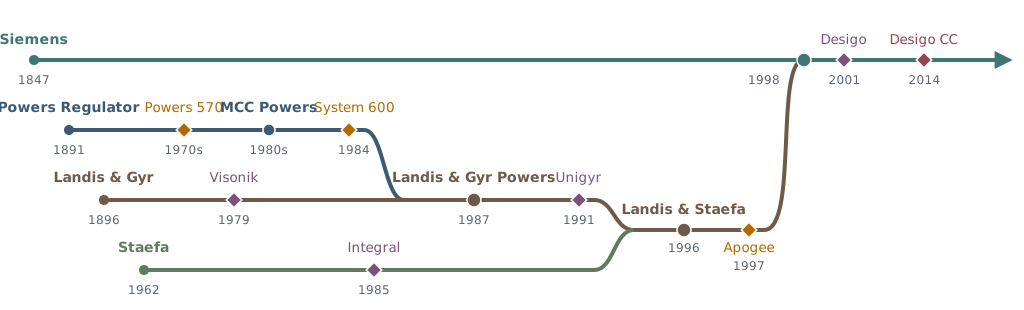 Lines are companies, diamonds are products.
The American Branch: Powers, System 600, Apogee
Here’s the thing nobody at Siemens will put on a slide: the Apogee system that runs thousands of North American buildings is, underneath the paint, the Powers System 600. The giveaway is the programming language. It’s called PPCL, and the first P stands for Powers — a name Siemens scrubbed from the panels in 1998, even as the language kept shipping with new hardware for decades. Powers itself is not quite gone, by the way: it lives on as a Watts brand, back to its 1891 roots of regulating water temperature — these days as anti-scald shower valves. So the company that gave building automation its control language now tempers your shower, while somewhere an engineer writes PPCL for a firm that removed its author from the nameplate. There’s probably a German word for that.
Architecturally, Apogee is two tiers, and the tier names matter more than any product name. The upper tier is the Building-Level Network (BLN — or ALN on newer gear, because one name would have been too easy), where the field panels — MBC, MEC, PXC Compact, PXC Modular — talk to each other and to the workstation in the proprietary P2 protocol — on RS-485 trunks at first, over Ethernet later. The oldest P2 variant carries a lovely fossil: point names encoded in RAD-50, a character-squeezing scheme Digital Equipment invented for the PDP-11. If ancient point names look short, uppercase, and allergic to punctuation, blame the memory budget of a 1970s minicomputer; Apogee-era P2 switched to plain ASCII. The panels also run a Telnet terminal where the factory passwords are traditionally low, med, and high — security was a more trusting place in the nineties.
The lower tier is the Floor-Level Network (FLN): the RS-485 bus under each panel where the TECs and unitary controllers live, speaking the P1 protocol. P1 is remarkably stable across generations — a TEC bolted to a VAV box in 1992 and one installed in 2015 will often chat on the same trunk without complaint.
Then there’s the workstation tragedy. Above the panels sat Apogee Insight — a Windows workstation whose ancestors were literally named Insight for Minicomputers and Insight for Personal Computers. Siemens stopped selling it around 2020 and pulled the plug entirely in January 2022. The field hardware didn’t get the memo — the panels and TECs keep running beautifully. What died is the screen you look at them with. Thousands of buildings now have a perfectly healthy nervous system and no face — and the official cure, sold by the same company that declared the illness, is a full Desigo CC project. This one decision is why more Siemens sites land on integrators’ desks than anything else.
To be fair, Siemens built an escape hatch into the hardware itself. Late-generation Apogee runs on open protocols: newer TECs ship as BACnet MS/TP devices, and PXC panels can be loaded with BACnet firmware instead of P2 — the same box comes back up as a standard BACnet/IP field panel. If your site has been converted, or can be, the whole proprietary question evaporates. The catch: conversion is a project of its own, panel by panel, and plenty of sites are still P2 all the way down.
The European Branch: Landis & Gyr, Staefa, Desigo
While Powers was wiring up America, Landis & Gyr and Staefa were doing the same for Europe with Visonik, Unigyr, and Integral — product names that sound like they should be engraved on a Swiss watch, and were about as proprietary. After the mergers, this lineage produced Desigo: PX automation stations with the Desigo Insight workstation — no relation to Apogee Insight beyond the name, because apparently one company having two unrelated products called Insight was fine with everyone.
The early Desigo PX generations have a genuinely odd party trick: they speak BACnet over LonTalk. That’s standard BACnet objects — open protocol, self-describing points, the works — delivered over LonWorks FTT-10 twisted-pair wiring. It’s a sentence that makes BACnet people and LON people equally uneasy, and it’s the single detail that decides your integration path. A later PX with BACnet/IP firmware is an open book for any BACnet client; an older LonTalk-generation PX needs something that can carry BACnet over the LON wire. The current generation has gone fully open: the PXC4/5/7 stations and DXR room controllers are BTL-listed native BACnet devices. Meanwhile Desigo Insight followed its American cousin into retirement (support ended December 2022), so European sites are now discovering the healthy-body-no-face problem for themselves.
Wait — BACnet over LonTalk? Whose idea was that?
ASHRAE’s, actually. The original BACnet standard of 1995 defined five ways to move BACnet messages: Ethernet, ARCNET, MS/TP, point-to-point dial-up — and LonTalk, the odd one out: a proprietary protocol from Echelon Corporation, baked into their Neuron chip. It got in anyway, because LonWorks was a serious market force in the mid-nineties protocol wars.
The crucial subtlety is that BACnet only borrowed LonTalk’s envelope, never its language. A BACnet-over-LonTalk device and a LonWorks device can share the same wire in polite mutual incomprehension, like two people using the same postal service to write letters in different alphabets. And here’s the connection that makes this a Siemens story: by 1996, Staefa had already demonstrated BACnet devices running the whole stack inside a Neuron chip. Staefa — the company that two mergers later became the Desigo side of Siemens. The “odd party trick” of Desigo PX isn’t odd at all: it’s the direct descendant of a mid-nineties bet that BACnet would win the application layer while LON won the wire. Both halves of that bet aged differently, which is why your PX now needs a driver to carry its perfectly standard BACnet across its no-longer-standard trunk. Three decades on, Siemens remains essentially the only player who ever shipped BACnet-over-LonTalk products at scale.
Three Things Called PXC
One more trap, and it’s a good one: “PXC” does not tell you what you have. Siemens used the same three letters — and largely the same grey hardware — across both family trees. An Apogee PXC Compact or Modular runs P2 firmware and lives on the BLN/ALN. The same PXC series platform also shipped with BACnet firmware. And over in the European tree, the Desigo PX automation stations are also named PXC, speaking BACnet over LonTalk or BACnet/IP depending on generation.
In the field, the quickest tell is the terminal block: the LonTalk variants carry the characteristic blue FTT-10 LON terminals. Blue terminals mean a LON trunk, which means the BACnet-over-LonTalk generation. No blue terminals and an Ethernet jack means you check the firmware: it’s either P2 (Apogee) or BACnet/IP (Desigo), and the difference is your entire integration plan.
The Third Siemens: Simatic
Here’s a twist worth noticing: everything above — Apogee, Desigo, both Insights — came to Siemens by acquisition. The building automation division is a collection of other people’s inventions wearing one logo. The homegrown Siemens automation product is a different beast entirely: Simatic, born in 1958, two decades before DDC reached buildings. By the time Siemens Building Technologies was established in 1998, Simatic PLCs had already been running factories for a generation. The building division was the new kid in its own company.
And Simatic does not stay in the factory. It lives at the semi-industrial edges of the built environment: pump stations, water treatment works, district heating substations, CHP plants, tunnels — and inside packaged equipment, where an OEM ships a machine with an S7 or a LOGO already wired in as its brain. These arrive through industrial contractors and machine builders who have never heard of Desigo. So a site can genuinely end up with two unrelated Siemens control systems: whichever family tree its continent got — Apogee in North America, Desigo in Europe — plus a PLC that predates both divisions and speaks to neither.
The Reunion: Desigo CC and Building X
In 2014, sixteen years after buying both families, Siemens finally introduced them to each other: Desigo CC manages Apogee panels and Desigo controllers alike, plus fire, security, and energy. In 2022 the Building X cloud layer landed on top. Desigo CC is genuinely capable — and it’s a full-scale BMS platform, priced and scoped accordingly, that commits the building to one vendor for another generation — and, given the track record above, to whatever gets end-of-lifed next. For many owners the better deal is to keep the field hardware that works and get the data into an open framework like Niagara — without a forklift, and without signing up for the next rebrand.
And if you need a second opinion on that open-framework idea, ask Siemens. Their US catalog includes yet another building automation line: TALON, sold through smaller contractors — and built on Tridium Niagara. After a century of acquiring, rebranding, and retiring proprietary systems, even Siemens sells the open platform — although it still can’t talk to the other Siemens families without our drivers.
Which System Do You Have?
Match the hardware on site to a row: each one gives the protocol, the era, and the path into Niagara.
| What you find on site | Network / protocol | Era | Path into Niagara |
|---|---|---|---|
| TECs and unitary controllers on an RS-485 trunk — panel dead, missing, or never there | FLN — P1 over RS-485 | ~1990–2020s | Wire the trunk to a Niagara RS-485 port and poll the TECs directly with the Apogee P1 driver. Device and point discovery included; no panel required. |
| Apogee field panels with Ethernet — PXC Compact, PXC Modular, Power MEC, MBC | BLN/ALN — P2 over Ethernet | ~2000–2020s | Join the BLN as a node with the Apogee P2 driver. One TCP connection reaches every panel on the BLN and every FLN device under them, with COV updates and priority handling. |
| Older Apogee panels on an RS-485 BLN trunk — no Ethernet in sight | BLN — P2 over RS-485 | ~1990–2005 | Also the Apogee P2 driver: wire the trunk to a Niagara RS-485 port and the driver talks P2 on the wire directly. |
| Desigo PX (PXC) controllers with blue FTT-10 LON terminals on a twisted-pair trunk | BACnet over LonTalk | ~2001–2015 | JACE with a LON option card plus the Desigo PX driver, which runs the standard Niagara BACnet stack over the LON trunk. |
| Native BACnet gear from either tree — Desigo PX/PXC4/5/7, DXR room controllers, BACnet TECs, or Apogee PXC panels converted with BACnet firmware | BACnet/IP or BACnet MS/TP | ~2010–today | Nothing to buy — the standard Niagara BACnet driver does it. If someone tries to sell you a gateway for these, walk away. |
| A Desigo CC server that has to stay (fire, security, or contractual reasons) | NORIS RESTful API, HTTPS | 2014–today | The Desigo CC driver connects to the NORIS interface with OAuth 2.0 and exposes objects from every discipline as Niagara points — a clean way to feed the data into a third-party system while the original installation keeps running untouched. |
| A Simatic PLC running the plant room — S7-300/400, S7-1200/1500, or even a LOGO | S7comm over Ethernet | 1995–today | The Simatic S7 driver connects by IP, rack, and slot, and reads or writes any memory area. |
| Visonik, Unigyr, or Integral equipment | Proprietary pre-Desigo networks | 1980s–1990s | You really have these? And they still work? Call a museum. Then plan a replacement — there is no practical route in. |
Buildings Outlive Companies
A building’s lifespan is measured in decades; a product line’s is measured in reorgs. The hardware layer of a Siemens building is usually the healthiest thing in it — what keeps dying is the software you’re supposed to view it through, on a schedule set in a boardroom rather than a boiler room. So before anyone quotes you a rip-and-replace: figure out which family tree your gear belongs to, and check the table. Every row up there is a retrofit we’ve actually done — the drivers exist because the buildings do.
Driver guides, licensing, and trial downloads are at baudrate.io.
A note on accuracy: this history was pieced together from open sources, old datasheets, and a certain amount of plant-room folklore. We build drivers, not corporate chronicles — if we got a date or a merger wrong, tell us and we will fix it.